Quantum Computing Concepts
Four ideas that make quantum different from classical computing
The building block
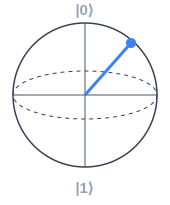
Qubit
A classical bit is strictly 0 or 1. A qubit can hold a weighted blend of both at once, until it is measured and settles on a single value. That blend is the room a quantum computer has to work in.
Qubits exhibit quantum phenomena
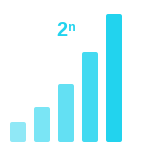
Superposition
A group of qubits can represent an enormous number of possibilities at the same time. Just 50 qubits can encode on the order of a quadrillion (10^15) combinations at once, far beyond a classical register of the same size.

Entanglement
Qubits can be linked so that measuring one immediately constrains another. Entanglement is how a quantum computer represents rich, joint relationships across many variables at the same time.

Interference
A quantum algorithm is arranged so the paths that lead to correct answers reinforce each other, while the wrong ones cancel out. Interference is what turns raw superposition into a useful result.
Why quantum computing is powerful
The advantage is better scaling
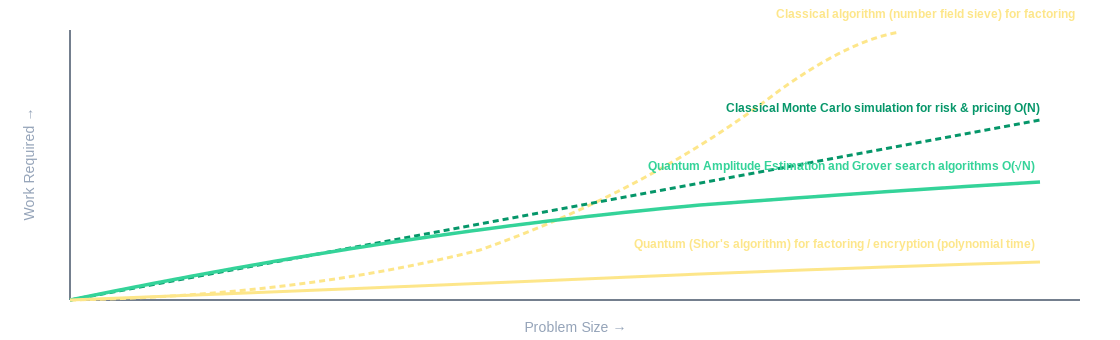
Quantum computers are not universally faster. They are specialized accelerators: for problems with the right mathematical structure, the work a quantum algorithm needs increases far more slowly as the problem grows.
Quadratic speedup
N → √NQuantum Amplitude Estimation and Grover-style search cut simulation, pricing, and search problems from roughly N steps to about the square root of N. For example, with the Monte Carlo methods banks run on risk and derivatives, that is a large, practical saving as problem sizes grow.
Exponential speedup
impractical → efficientFor a few special problems, such as factoring large numbers with Shor's algorithm, quantum computing moves solutions from impractical to efficient. This is the basis of quantum computing's impact on cryptography.
A quantum computer is a specialized accelerator, not a universally faster computer. The value comes from matching the right problem to the right algorithm.
Three eras on the path to advantage
Quantum-Inspired
Quantum-inspired methods such as tensor networks run on ordinary classical hardware and deliver value now. AQS uses them, for example, to capture market structure that standard models miss.
Noisy Intermediate-Scale Quantum
Today's real quantum processors are noisy and limited in scale. They run genuine quantum algorithms and are proving grounds for learning and heuristics, though a clear advantage is not yet proven.
Fault-Tolerant
Error-corrected machines will unlock provable speedups on problems beyond classical reach. Fault-tolerant hardware may arrive sooner than the consensus expects.
Why quantum matters for finance
Hard math
Finance is full of stochastic and combinatorial problems, a natural fit for quantum computation.
High value
Billions ride on these calculations, so even a small edge compounds into real impact.
Better results
Quantum and quantum-inspired models can capture relationships, such as joint tail risk, that classical models miss.
The same opportunity drives quantum approaches in other fields, such as drug discovery, materials science, and logistics.
Put quantum to work in finance
AQS FabriQ lets quant teams run financial use cases across classical, quantum-inspired, and quantum methods, and benchmark them side by side.
For the technically curious, read our latest paper on arXiv.